


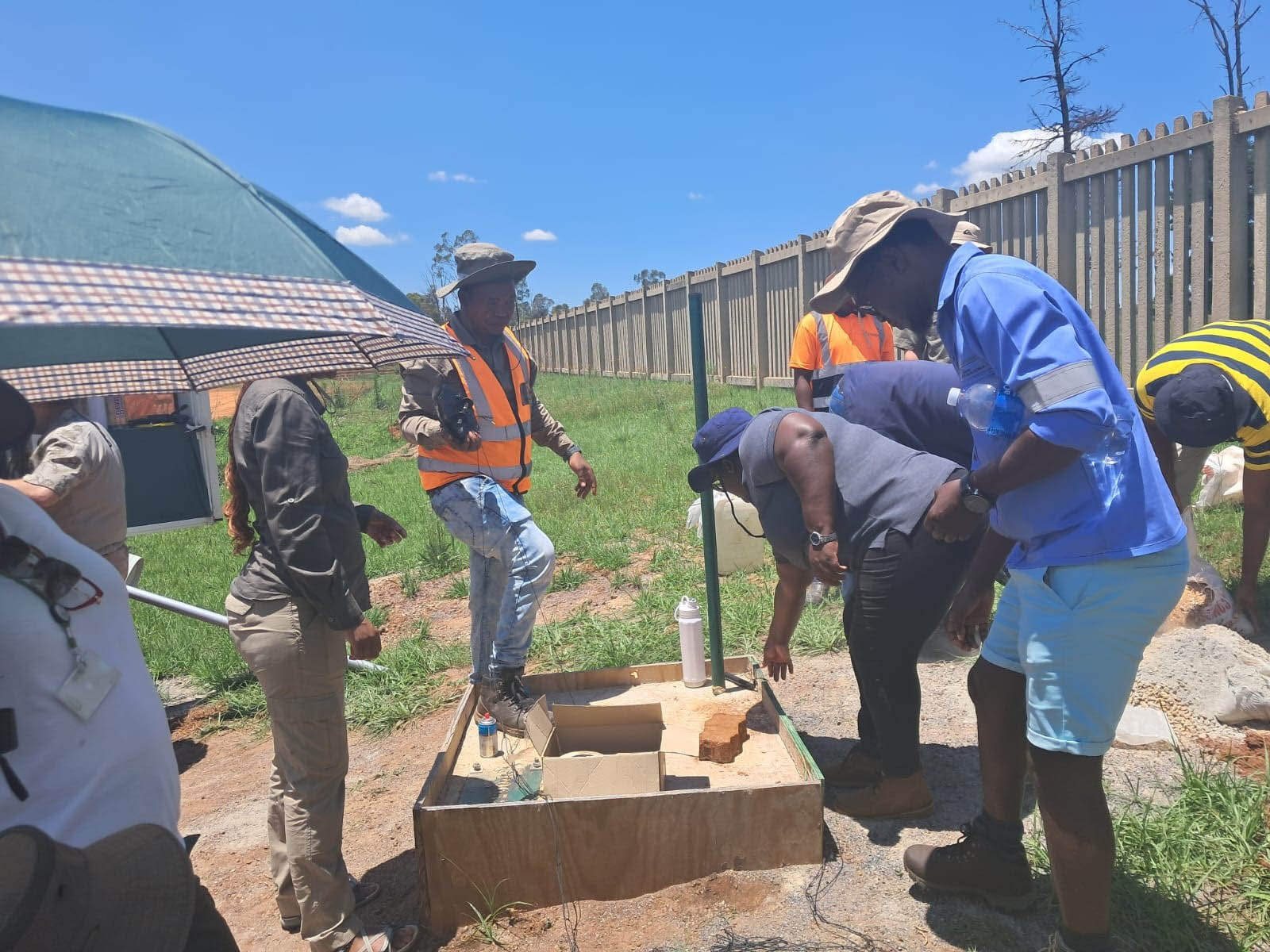
Collaboration in full swing. Transforming our vision into reality, one milestone at a time.”
Strengthening Water Security: Establishing a Groundwater Baseline in the Upper Vaal Catchment
Water is the lifeblood of sustainable development, and in a water-scarce nation like South Africa, groundwater is an invaluable, yet often invisible resource. To manage this resource effectively, one must first understand it. Recognizing this, the Department of Water and Sanitation (RSA), with the vital support of the SADC Groundwater Management Institute (SADC-GMI), and financial support from the Global Environment Facility (GEF) and the Cooperation in International Waters in Africa (CIWA) through the World Bank Group, successfully established a baseline monitoring network in the Upper Vaal Catchment of Gauteng Province.
This initiative is a proactive step towards filling critical data gaps, ensuring that evidence-based decision-making becomes the cornerstone of groundwater management in one of the country’s most vital economic hubs, Gauteng Province.
The Challenge: Visibility in a Hidden Resource
For some time, inadequate spatial coverage for monitoring groundwater quality and levels hindered effective management. While surface water monitoring networks were relatively well-established, groundwater, which serves as a critical buffer during droughts, often lacked sufficient observation points.
The need for a more robust network was underscored by a 2017 Department of Water and Sanitation (DWS) study on the Review, Evaluation, and Optimization of Water Resource Monitoring Networks, which identified significant shortcomings. These concerns were further amplified during the 2018 Sustainable Development Goals (SDGs) reporting process. It became clear that without reliable data on groundwater levels and quality across a wider geographical area, the ability to manage this resource sustainably was compromised.
The Upper Vaal Catchment, including the groundwater Strategic Water Source Areas (SWSAs), was identified as a priority area in which filling these data gaps was non-negotiable.
The Intervention: Building a Foundation for Knowledge
The project’s objective was ambitious: to establish ten baseline monitoring sites within the Upper Vaal. Despite encountering site access challenges that necessitated a slight adjustment to the initial target, the project team successfully established eight robust baseline monitoring sites.
This network is a blend of innovation and integration:
- Three new boreholes were drilled specifically for monitoring purposes.
- Five existing boreholes were adopted and upgraded to form part of the network.
Each of these eight sites is now equipped with high-precision monitoring technology, including data loggers and barologgers, to ensure continuous and accurate recording of groundwater conditions. To provide a comprehensive view of the hydrological cycle, the sites are complemented by rainfall samplers, and one site has been fitted with a dedicated rain-gauge station.
By incorporating springs and aligning these new points with existing surface water monitoring, the project created a cohesive, data-rich landscape for the Upper Vaal Catchment.
Impact: Data-Driven Governance
While the project does not include a direct community livelihood component—such as a reticulation system—it has a profound impact on national water security. The primary beneficiary is the government, specifically the Department of Water and Sanitation of the Republic of South Africa (DWS), which now has a consistent, reliable stream of data that supports evidence-based decision-making and resource planning.
By closing the spatial gaps that previously hampered groundwater management, the project transforms how the region assesses and estimates groundwater recharge in key aquifers. This data is not sitting idle; it is being integrated into crucial national databases, including HYDSTRA, WMS, and the National Groundwater Archive (NGA). Furthermore, this information will be shared with key external stakeholders, such as farmers and South African National Parks (SANPARKS), and submitted to the SADC-GMI for integration into the regional SADC Groundwater Information Portal.
In short, the project provides the “intel” required to make informed decisions that protect water resources for future generations.
Ensuring Sustainability: A Commitment to Vigilance
The true value of a monitoring network lies in its continuity. To ensure the long-term sustainability of the Upper Vaal network, the DWS has committed to a rigorous maintenance and monitoring schedule:
Quarterly Monitoring: Data will be collected and analyzed every three months.
Regular Inspections: Every site visit includes a thorough technical inspection to ensure all equipment is functional.
Proactive Maintenance: Any faulty equipment will be repaired or replaced immediately to ensure the integrity of the data remains uncompromised.
Reporting: The data collected will form the basis of quarterly reports, fueling a cycle of continuous assessment and improvement.
A Step Toward Regional Resilience
The establishment of this baseline monitoring network is more than a technical achievement; it is a testament to the power of collaboration between the Government of the Republic of South Africa through the Department of Water and Sanitation (DWS), the SADC Groundwater Management Institute (SADC-GMI), and the Funders (CIWA, GEF, and the World Bank). “By systematically mapping the hidden water of the Upper Vaal, we are no longer managing our groundwater in the dark,” asserts Ms. Elelwani Netshitanini, Project Manager from the Department of Water and Sanitation.
“As we look toward the future, this network serves as a cornerstone of climate resilience, ensuring the province has the evidence it needs to protect, manage, and sustainably use its groundwater resources for the benefit of all”, she concluded.
For more information on regional groundwater initiatives and to track the progress of this and other projects, visit the (https://sadc-gmi.org/project/current-projects/).